Reactive Systems and DDS: A Perfect Match for Mission-Critical Systems
When building mission-critical systems, reactivity isn’t just a nice-to-have—it’s a must. I’ve learned that the best systems aren’t just fast—they’re resilient, scalable, and responsive. That’s where DDS (Data Distribution Service) comes into play, and it aligns perfectly with the Reactive Manifesto for building robust reactive systems.
Reactive systems
🎯 Message-Driven Systems
Reactive systems focus on asynchronous message passing, which promotes loose coupling between components. That’s exactly how DDS operates. DDS acts as the communication backbone for real-time data exchange, ensuring that your system components (sensors, controllers, etc.) can communicate efficiently and reliably.
💪 Resilient and Fault-Tolerant
In mission-critical environments, failures are not just possible—they’re expected. DDS shines here by enabling fault tolerance and automatic recovery even when communication links are unreliable. Whether you’re working with autonomous systems or military applications, DDS ensures availability even under the most demanding conditions.
📈 Elastic Scaling
Building a system that scales is non-negotiable today. DDS allows you to scale up from a few to thousands of nodes effortlessly, making sure your system can handle changing workloads without a hitch. Dynamic resource allocation is another DDS feature that plays well with the elasticity requirement of reactive systems.
⏱ Real-Time Responsiveness
Low latency and high throughput are essential when you need your system to respond in real time. DDS guarantees fast communication, which is critical whether you’re working on autonomous vehicles, robotics, or IoT systems that require immediate responses to sensor inputs.
🔧 Maintainable and Extensible Systems
With DDS, you get a system that’s not just easy to maintain but also extensible. Its open standard allows seamless integration, future-proofing your systems for easy updates and adding new components.
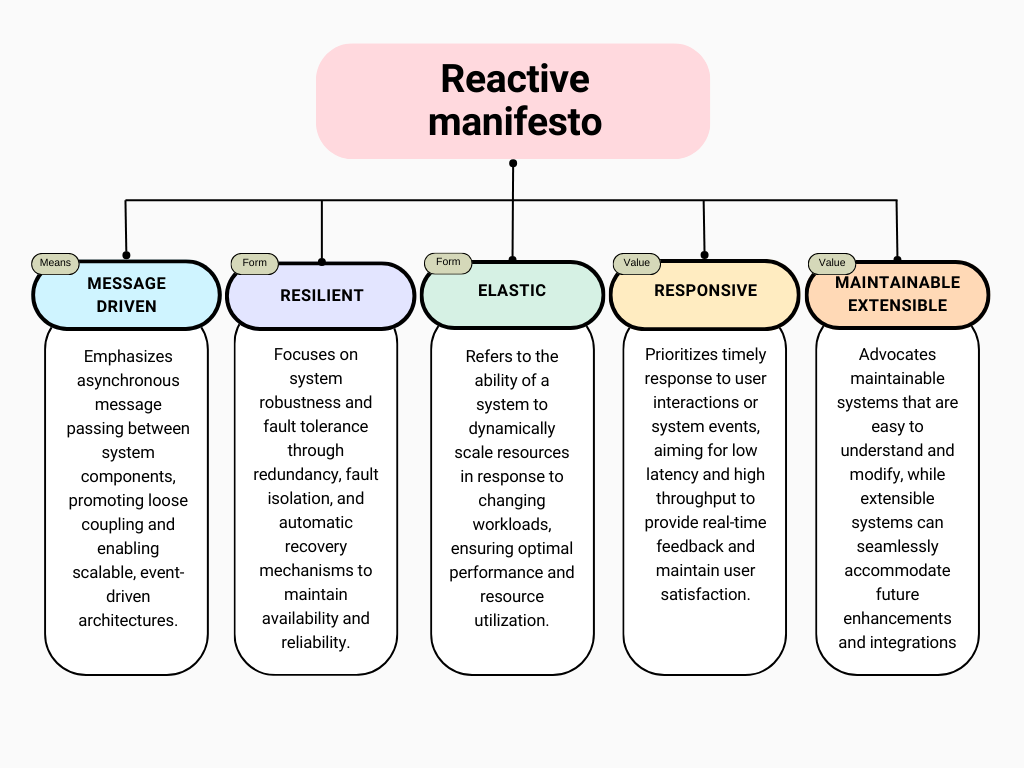
The picture above is inspired from https://www.reactivemanifesto.org/ and highlights the core elements of a reactive system by organizing them into means, form, and values:
- Means (How is built):
- Message-Driven: The system relies on asynchronous message passing between its components. This decouples system parts, allowing for flexible and scalable communication that doesn’t depend on direct connections.
- Form (Design):
- Elastic: The system is able to scale resources up or down based on demand. This flexibility ensures optimal performance under varying workloads.
- Resilient: The system is designed to handle failures gracefully by isolating problems and recovering automatically, maintaining reliability and availability.
- Values (Priorities):
- Responsive: Ensuring a quick reaction to inputs or events, providing timely feedback and interaction with users or other systems, which enhances the overall user experience.
- Maintainable & Extensible: The system is easy to understand, modify, and upgrade, making it future-proof and capable of handling new technologies and demands with minimal friction.
This structure emphasizes how reactive systems are built with messaging as their foundation, are designed to adapt and recover, and prioritize responsiveness, maintainability, and growth over time.